
Negative Space
the loser's chorus.

LU
She flipped me alabaster and lukewarm. Steady. Everyone else seemed like they’d kill me if they knew what was inside.
I’d play out her day in my head. Close my eyes and conjure her mornings. My insides in her form. Feeling the weight of her comforter. Her muscles (my muscles) going tense stretching out of bed, then rubbery. Fabric slushing soft and loose against her skin (my skin). I’d sit inside her face as she’d eat toast and cereal and grapefruits. Feeling it crumble down her throat (my throat). Dust playing off our skin in the warm nuclear light.
I’d feel her walking across pavement, my feet in her shoes, the wind yielding over our face and body. Our hands in her pockets. Alabaster and lukewarm.
People would have killed me if they knew about that.
At the start of the year I finally read a book that had been on the edge of my radar since it came out and it hit me with the kind intensity and depth that maybe one book in a decade has. Negative Space by B.R. Yeager is a book about the damage and violence that's so specific to growing up some combination of queer, poor, and isolated in the edge lands of a small towns, rural wastes, and industrial decline. It's also a book about love, self harm, drugs, magic, the internet, as well as the utter collapse of meaning that all of those five things lead to.
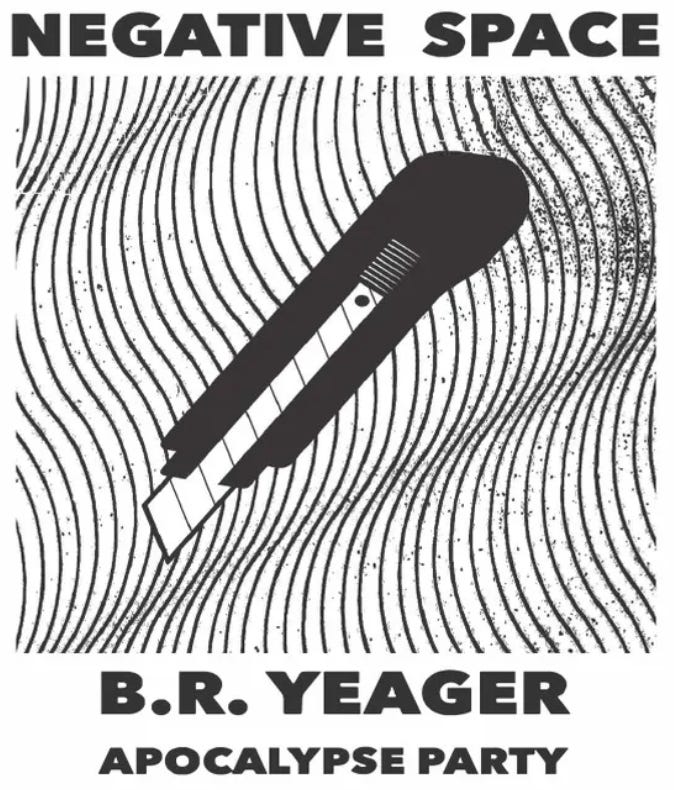
It's a book told from the point of view of three young people that I instantly recognised parts of in myself and those I grew up with. There is something specific about exclusion at the rural edges. The structure of urban space segregates, but by sheer density alone the odds of connections increase. In an urban space the social is stacked many times, first by the large filters like class, language etc, and then at a granular level of desire. Urban space is compressed, not just with vertical population density but with lateral transit infrastructure and temporal capacity for rapid change via cycles of gentrification, fashion, and technology. The number of potential connections in urban space is exponentially larger than in a rural space, even adjusting for raw population numbers. Lack of options for employment, familial support, and transit limit range. People are forced together as if sheltering under a wide sky. There is space, but it has a very different quality when there are only 3 buses a day and they only go between two places.
In rural space there is simple less material from which to build social strata, and so there are less layers and those that are present are lumpy and thin in places. For the young especially there is limited options to be discerning, to find your people. You simply work with what is there. The kid whose lone parent rides a bike shaking from Olanzapine side effects to clean houses, waits at the same bus stop as the kid whose house is being cleaned. That middle class kid will sell drugs to the poor kid at a markup, but they still wont have many people to take them with. Certainly won’t have anyone else whose guardian is out of the house for 10 hours a day and barely present the other 14.
Obviously, options for connection diminish with resources. If you’re poor as a young person in rural space your life can be very small. If you’re otherwise marked as as edge case of that lumpy social strata, you might well find yourself slipping through one of its thin edges and finding yourself among the fragments beneath. Being queer, being unwell, being marked with some hereditary stain, these are things which can push you outside.
In his 1934 text ‘Abjection and Miserable Forms’ Georges Bataille seeks to analyse the lumpen as exterior to the dichotomy of class struggle, and examine its psychological context. For Bataille, the abject, or ‘misérables’ are those outside the balancing process of labour and capital. In a manner similar to the sovereign who is excluded from all oppression, the abject are those excluded from any capacity to act upon the strata. The abject and sovereign are not balanced against one another, and their exclusion from the struggle of the homogenous middle is not equal.
‘The splendor of sovereignty is merely the consequence of the movement of aversion which elevates it above the impure mass. Miserable exploitation is abandoned to the organizers of production […], especially the police, […] a section of the population which is itself miserable’
The sovereign is above all checks and balances of oppression and subjugation, neither experiencing the latter or needing to enact the former. In contrast the misérables are a heterogenous mass riddled with internal division that result in an ‘infinite subjugation’. The sovereign does not experience oppression as a thing given or received. The underclass, or rather the infinite subdivisions in place of a defined class, subjugates itself. As Sylvère Lotringer observes, ‘people don’t just become abject because they’re treated like a thing, but because they become things to themselves’.
Negative Space is a book about young people rendered abject in North-Eastern United States. Even before that process fully locks into its death spiral, there is a debilitating struggle to articulate that each deals with, or rather fails to deal with. It's one of those points of suspended disbelief that has become a trope in horror about young people that they will always speak with the eloquence of the author. Stephen King is exemplary at this. Every one of his teenage characters from the disenfranchised youth of the Long Walk, to Mark Petrie from Salem’s Lot, to the Loser’s Club of It speaks like they've already lived a lifetime. King’s losers are never been lost for words, even if those words are simple. In contrast the kids in Negative Space can speak, but what Yeager understands is that being a certain kind of teenager means being constantly being choked off short by shame, fear, bravado, and longing. It is through this lack that via the charismatic exploitation of the fourth character Tyler they slip down into the realm of the misérables. The dialogue of the novel is full of the painful growths that block connection and fester with everything that can't even be rendered as language internally. Connection, solidarity, love, communication all these things become poisoned with mutual subjugation. The development of the first person characters over the course of the novel can be thought of as a increase of awareness, combined with a decrease in agency. The slow uptick in sense data, along with the decline of capacity (physical, mental, moral) to do anything with this, or to even speak it. You can think of this as a extreme form of “show don’t tell” where the space of “showing” is more and more beyond the sight of anything but the reader.
Structurally, Negative Space is framed with a rolling increase of suicides that begin to dominate a small town. This is a phenomenon that has happened to lesser degree in the town previously, but it returns and accelerates over the course of the novel. Along with this increase in frequency, comes the completely desensitisation, not just from the protagonists who have different degrees of awareness of what led to the deaths, but from the town community as a whole. This is where the novel departs from the tone of something like Junji Ito’s Uzumaki, or the work of Laird Barron or Thomas Ligotti. Negative Space avoids the cosmic horror meta of the depth of the water only becoming apparent when we find ourselves panicking too far from land to return. Instead the war against humanity grows as a rot of nihilism through everything. By the time the football field is hung with sad corpses, they are nothing but a source of irony.
While the book removes agency from its characters as they become things to themselves, it in turn gives space to its reader to summon their own agency. Negative Space doesn’t really offer us hope, or at least it doesn’t explicitly. However, for those that go looking for it hope can be dug up from the mud and ash. Characters grow new ways of connecting though ritual and touch. For at least one of the protagonists this amounts to a new kind of love that ultimately becomes transcendental, an uncursed death. As the protagonists lose the ability to tell their story, or to even take in their situation, that blackness becomes the space where a reader can draw their own diagrams. Where Negative Space especially succeeds is in seducing the reader to invest so fully in the characters and world that as everything collapses into a sort of dementia there is no choice but to traverse between the threads that are left. I know that for me, this investment is down to complete recognition I have of all three voices, as well as the crucial fourth voice of Tyler who so often is what is being spoken of. Tyler is the closest thing Negative Space has to a main character, but one we only ever encounter via the far more fragile and shame filled three that speak through the page. Tyler is the middle class kid that has learned that the losers can be rendered into a material for his own utility through cycles of abuse and affection, and sowed mistrust. Tyler performs the role of the cop from Bataille’s analysis. He enforces rules that are underpinned by a foundation of nihilism, demanding the complete separation and detachment. Of course as is always the case in such dynamics, Tyler the first to leave, leaving the remainder adrift.
Bataille, Georges (1999), ‘Abjection and Miserable Forms’ (ed. S. Lotringer; tran. Y. Sharir), in S. Lotringer (ed), More & Less 2, Cambridge, Massachusetts: MIT Press, pp. 8–14.
Lotringer, Sylvère (1999), ‘Les Miserables’, Cambridge, Massachusetts: MIT Press, pp. 2–7.